

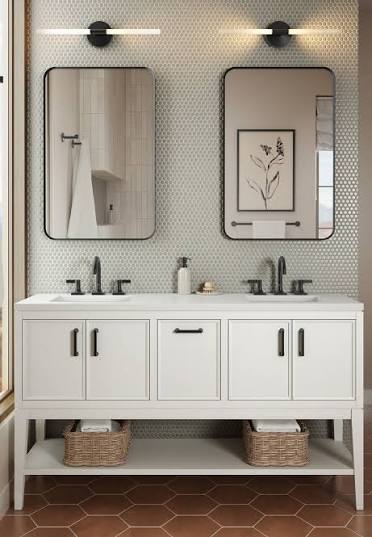
Mirrored Medicine Cabinets: A Buyer’s Guide to Function and Fit
There’s a reason mirrored medicine cabinets show up in almost every bathroom renovation checklist. They solve the mirror question and the storage question in one purchase, which sounds simple until you’re actually standing in a showroom comparing a dozen nearly identical-looking options. The differences that matter are rarely visible from three feet away.
Why This Fixture Carries So Much Weight
A bathroom mirror gets used every single day, often more than any other fixture in the room. When that mirror also holds medication, toiletries, and daily essentials, its placement and construction affect the whole morning routine, not just the room’s appearance.
This dual role is why buyers tend to spend more time on this decision than on other fixtures. A few points worth thinking through before comparing products:
- How much daily storage the household actually needs versus how much the cabinet visually promises
- Whether the mirror will serve one person or get shared by multiple people at different heights
- Whether the existing wall can support a recessed cutout or needs a surface-mount instead
- How much natural or vanity light already reaches that wall
Getting these questions answered early makes the actual shopping process much faster, since it narrows the field before finish and style even enter the conversation.
Reading Past the Marketing Photos
Product photos flatter almost every cabinet on the market, so the specifications matter more than the image. A few areas consistently separate a cabinet that lasts from one that doesn’t:
- Interior depth. Anything under 4 inches struggles to hold standard-height bottles upright; look for at least 4.5 inches if daily toiletries are going inside.
- Shelf material and adjustability. Tempered glass shelves that move up and down beat fixed plastic shelves, especially for households with mixed bottle heights.
- Hinge quality. Soft-close hardware costs more upfront but avoids the sagging and misalignment that cheaper spring hinges develop within a year or two of daily use.
- Mirror edge treatment. A polished or beveled edge holds up better against chipping than a raw-cut edge, particularly in a household with kids.
- Frame material. Stainless steel and powder-coated aluminum resist the humidity that eventually warps untreated wood-composite frames.
If the cabinet includes built-in lighting, a CRI rating of 90 or above renders skin tone accurately, which matters more for a mirror used for grooming and makeup than it does for general room lighting. Adjustable color temperature between roughly 3000K and 6000K also lets the same fixture work for both a warm evening routine and a brighter morning one.
Installation Decisions That Are Easy to Get Wrong
Most of the regret buyers report after installing mirrored medicine cabinets traces back to a handful of avoidable mistakes made before the cabinet ever went on the wall:
- Choosing recessed without confirming wall depth. A recessed unit needs enough clearance inside the wall cavity to avoid hitting plumbing lines or electrical runs, and that isn’t always visible from the outside.
- Mounting at a fixed “standard” height. The typical guideline works for an average adult, but a household with a notably tall or short primary user should measure against that person directly.
- Skipping outlet planning. If an electric razor, toothbrush charger, or hair tool needs to sit near the mirror, the outlet has to be positioned before the wall closes up, not improvised afterward.
- Ignoring door swing. A door hinged on the wrong side can hit a nearby light fixture, towel bar, or shower door in a tight layout; a double-door or sliding design solves this in narrow bathrooms.
- Rushing the leveling step. Even a well-built cabinet will develop a crooked door over time if it wasn’t leveled correctly during the initial mount.
None of these require special expertise to avoid, but they’re easy to overlook when a renovation is moving on a tight timeline and the mirror feels like a smaller decision than the vanity or the tile work.
Shopping With a Clear Checklist
Once the basics are settled, narrowing down an actual product gets a lot easier with a short checklist in hand:
- Confirm interior depth and shelf count against what actually needs to fit inside
- Decide recessed versus surface-mount based on the wall’s real depth, not preference alone
- Check whether lighting, an anti-fog coating, or built-in outlets are worth the added cost for that household
- Match the door swing and hinge side to the surrounding fixtures
Retailers such as Allsumhome list these specs directly on each product page, which makes it possible to compare depth, hinge type, and lighting features side by side rather than guessing from a photo alone.
The Bottom Line
A mirrored medicine cabinet has to hold up as both a mirror and a storage fixture, used multiple times a day for years. The mirror needs to stay clear and distortion-free, and the hardware behind it needs to keep working smoothly in a room that’s regularly humid. Taking the extra time to compare depth, hinge quality, and shelf material before buying is usually what separates a cabinet that still feels solid five years in from one that’s already loose and foggy well before then.
