

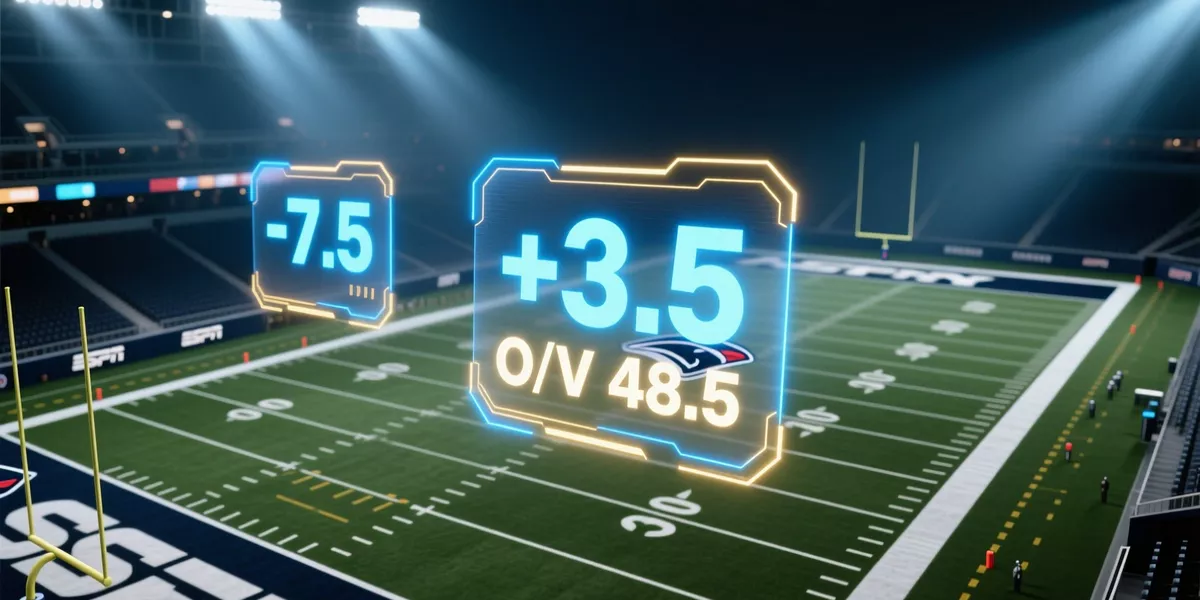
Point spread betting is one of the most common forms of sports wagering. Instead of simply choosing which team will win, the bettor chooses whether a team will win or lose by a specified margin. The spread essentially gives the underdog a points advantage while requiring the favorite to overcome a handicap.
For beginners, the numbers and plus/minus signs can initially look confusing. Once the basic concepts are understood, however, reading a spread becomes much more straightforward.
What Is a Point Spread?
A point spread is a handicap assigned to two competing teams. The stronger team is normally listed with a negative number, while the weaker team receives a positive number.
For example:
- Team A: -6.5
- Team B: +6.5
A bet on Team A requires Team A to win by 7 points or more. A bet on Team B wins if Team B wins outright or loses by 6 points or fewer.
The important point is that the final winner of the actual game is not necessarily the winner of the spread bet.
Understanding the Favorite and Underdog
The team with the negative spread is called the favorite. The team with the positive spread is the underdog.
Suppose a basketball matchup is listed as:
Lions -8.5 vs. Tigers +8.5
If you select the Lions, they must win by at least nine points for the spread wager to succeed. If you select the Tigers, they can win the game outright or lose by eight points or fewer.
This is why a spread bet involves more than predicting which team is likely to win.
What Does “Cover the Spread” Mean?
“Covering the spread” means a team performs well enough against its assigned handicap for the wager to win.
Imagine a football team is listed at -4.5. If it wins 27–20, it has won by seven points and therefore covers the spread. If it wins 24–21, it has won by only three points and does not cover.
For an underdog at +4.5, losing by three points would still constitute covering the spread.
What Does + and – Mean?
The symbols are among the first things beginners should learn.
Negative Number (-)
A negative number normally identifies the favorite. The favorite is giving points and must win by more than the listed spread.
Example:
Team A -5.5 means Team A needs to win by at least six points.
Positive Number (+)
A positive number normally identifies the underdog. The underdog receives points for betting purposes.
Example:
Team B +5.5 wins the spread bet if it wins outright or loses by five points or fewer.
The plus or minus sign is therefore directly connected to how the final score is evaluated.
What Are the Betting Odds Next to the Spread?
The spread and the betting odds are two different things.
Consider:
Team A -7.5 (-110)
The -7.5 represents the point spread. The -110 represents the price of the wager.
In markets using American odds, -110 generally means a bettor would need to risk $110 to make $100 in profit, before considering the return of the original stake. Sportsbooks may use different odds formats depending on the market and jurisdiction.
Understanding this distinction helps prevent one of the most common beginner mistakes: confusing the spread with the payout.
What Is a Push?
A push occurs when the final result lands exactly on a whole-number spread.
For example, suppose a team is listed at -7 and wins by exactly seven points. Neither side wins the spread wager. The stake is generally returned.
Half-point spreads such as -7.5 are often used to eliminate the possibility of a standard push.
Point Spread vs. Moneyline Betting
Point spread and moneyline bets are different ways of approaching the same game.
A moneyline bet focuses on which team wins the game. A point spread bet considers the margin of victory as well.
For example, if Team A is heavily favored, its moneyline may have a relatively expensive price. Its spread might instead be -6.5, meaning the bettor needs Team A to win by at least seven points.
The choice between these markets therefore changes what needs to happen for the wager to succeed.
How Point Spread Betting Works in Different Sports
Point spreads are particularly common in sports such as football and basketball. The terminology can change in other sports.
For example, baseball commonly uses a run line, while hockey commonly uses a puck line. These markets apply a similar handicap concept but use the scoring characteristics of their respective sports.
Understanding the scoring system of a sport is therefore important when interpreting its handicap markets.
Why Do Sportsbooks Offer Point Spreads?
Point spreads provide another way to create a betting market when two teams have different perceived strengths.
Instead of asking bettors only to predict the winner, the spread asks them to consider the expected margin. This can make a matchup between a strong favorite and an underdog more competitive from a wagering perspective.
However, a spread should not be treated as a guarantee of the final margin. It is a market number that can change as information and betting activity develop.
Common Beginner Mistakes
New bettors can make several avoidable mistakes when learning point spreads.
One is focusing only on which team is better. A strong team can win a game but fail to cover a large spread.
Another is ignoring the number itself. A move from -2.5 to -3.5, for example, changes the margin required for a favorite to cover. In sports where certain margins occur frequently, half-point changes can be particularly meaningful.
Beginners should also avoid assuming that previous spread results guarantee future outcomes. Past performance against the spread does not determine what will happen in the next game.
A Simple Way to Read Any Spread
When you see a point spread, work through these steps:
- Identify the favorite. Look for the negative number.
- Identify the underdog. Look for the positive number.
- Read the margin. Determine how many points separate the two sides.
- Check the odds. The odds determine the wager’s price and potential return.
- Apply the spread to the final score. This determines whether the selected team covered.
- Check for a push. This is possible with certain whole-number spreads.
This simple process can make unfamiliar betting screens much easier to understand.
Responsible Betting Matters
Point spread betting involves financial risk, and understanding the mathematics does not remove that risk. A wager can lose even when a bettor has researched the teams carefully.
Anyone who chooses to participate should understand the applicable laws and age requirements in their jurisdiction and use only money they can afford to lose. Setting a predetermined entertainment budget and avoiding attempts to recover losses through larger wagers can help keep betting from becoming financially disruptive.
If you are reviewing a sportsbook or betting platform, including when considering whether to สมัคร UFABET, read the applicable terms, odds, fees, withdrawal conditions, and responsible-gambling provisions before depositing money.
Final Thoughts
Point spread betting becomes much easier once the basic relationship between the favorite, underdog, spread, and odds is understood. The central idea is simple: you are betting on performance relative to a handicap, not merely predicting the winner.
Start by practicing with hypothetical scores, learn how different spreads are settled, and make sure you understand the odds before considering any real-money wager.
